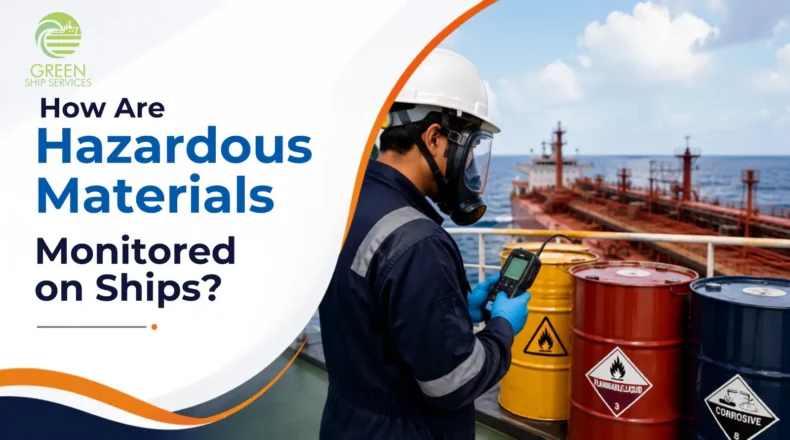
Safe ship operations require continuous awareness of hazardous substances. How are hazardous material levels monitored on board ships? Through documented IHM procedures, onboard inspections, sampling, labeling, recordkeeping, and periodic verification. Effective Inventory Hazardous Material on ships management helps identify asbestos, PCBs, ozone-depleting substances, heavy metals, and other regulated materials while supporting crew safety, regulatory compliance, and responsible ship recycling.
What Is IHM Maintenance on Ships?
IHM Maintenance is the ongoing process of keeping a vessel’s Inventory of Hazardous Materials (IHM) accurate and up to date throughout its operational life. When equipment, machinery, coatings, or materials are installed, removed, or replaced, relevant information should be assessed and incorporated into the vessel’s IHM.
For shipowners and operators, maintenance is not simply a one-time survey. It is a continuous documentation and verification process.
What Does IHM Maintenance Include?
A structured IHM Maintenance programme may involve:
- Reviewing the existing IHM
- Recording new equipment and materials
- Updating hazardous-material declarations
- Checking supplier documentation
- Conducting visual inspections
- Performing material sampling when required
- Maintaining supporting laboratory reports
- Updating locations and quantities
- Recording removal or replacement of hazardous materials
- Maintaining traceable IHM records
- Periodically verifying onboard information
How Are Hazardous Material Levels Monitored on Board Ships?
Hazardous material monitoring combines document review, visual inspection, sampling, testing, quantity estimation, and record updates. The exact approach depends on the material, vessel, applicable regulations, and risk profile. Book Our Services as consultant click: https://greenshipservices.in/contact-us/
| Monitoring method | What it helps establish |
| Document review | Existing information about materials and equipment |
| Visual inspection | Presence, condition, and location of suspected materials |
| Material sampling | Whether a suspected material contains a hazardous substance |
| Laboratory analysis | Supports identification and characterization |
| Quantity estimation | Helps maintain accurate IHM entries |
| Record verification | Confirms documentation matches onboard conditions |
| Periodic updates | Keeps the IHM current after modifications |
Hazardous material levels on ships are monitored through IHM document review, onboard inspections, material sampling, laboratory analysis, quantity assessment, and continuous record updating.
Which Hazardous Materials Are Typically Monitored?
The IHM framework can cover different hazardous substances identified under applicable maritime requirements. Common examples include:
- Asbestos
- Polychlorinated biphenyls (PCBs)
- Ozone-depleting substances
- Anti-fouling system substances
- Certain heavy metals
- Lead-containing materials
- Mercury
- Other hazardous substances identified under applicable requirements
The presence, location, quantity, and relevant documentation should be recorded according to the applicable IHM framework.
Why Is Inventory Hazardous Material on Ships Important?
Maintaining an accurate Inventory Hazardous Material on ships provides a structured picture of where hazardous substances are located and supports safer maintenance, repair, conversion, and recycling activities.
An inaccurate inventory can create uncertainty for:
- Crew members
- Ship-repair personnel
- Contractors
- Surveyors
- Ship recyclers
- Shipowners and managers
- Regulatory and compliance teams
IHM accuracy therefore becomes especially important when vessels undergo major repairs, retrofits, machinery replacement, or preparation for recycling.
What Is the Process for Hazardous Material Monitoring?
A practical monitoring workflow can be organized into the following stages:
- Review Existing Documentation
Surveyors review available ship plans, equipment specifications, supplier information, previous IHM documentation, and relevant material declarations.
- Conduct Onboard Inspection
Accessible areas, machinery, systems, components, and materials are examined to identify potential hazardous substances and verify existing IHM information.
- Identify Suspected Materials
Where documentary evidence is insufficient, potentially hazardous materials may be identified for further assessment.
- Collect Samples When Necessary
Sampling should be undertaken using appropriate procedures by competent personnel, particularly where material identification cannot be reliably established through documentation or visual inspection.
- Perform Laboratory Testing
Where required, samples can undergo suitable laboratory analysis to determine whether specific hazardous substances are present.
- Estimate Quantity and Location
The IHM should contain sufficiently useful information about the material’s location and quantity or estimated quantity, as applicable.
- Update the IHM
Verified findings are incorporated into the vessel’s IHM documentation, creating a traceable record for future maintenance and compliance activities.
When Should Shipowners Book a Hazardous Material Survey for Ships?
Shipowners may need to book hazardous material survey for ships when developing an initial IHM, verifying existing records, investigating suspected materials, undertaking significant modifications, or preparing for recycling.
A survey can also help identify discrepancies between historical documentation and actual onboard conditions.
Before appointing a provider, shipowners should evaluate:
- Relevant maritime experience
- Surveyor competency
- Sampling procedures
- Laboratory arrangements
- Reporting methodology
- IHM documentation capabilities
- Regulatory knowledge
- Traceability of findings
- Experience with ship recycling requirements
How Can a Hazardous Material Monitoring Company for Vessels Help?
A professional hazardous material monitoring company for vessels can support shipowners by combining technical inspection with systematic documentation.
A capable service provider should be able to assist with:
- IHM surveys
- Onboard inspections
- Hazardous-material identification
- Sampling coordination
- Laboratory testing
- Material quantity assessment
- IHM preparation
- IHM updating and maintenance
- Documentation review
- Recycling preparation
- Compliance-oriented reporting
The provider’s procedures should be aligned with the vessel’s applicable regulatory and classification requirements rather than relying on a generic checklist. Check customer’s Testimonial click: https://bit.ly/4bIu9Pg
How Does IHM Maintenance Support Ship Recycling?
Accurate IHM information becomes particularly valuable when a vessel reaches the end of its operational life. Ship recyclers need reliable information about hazardous materials before dismantling activities begin.
Effective IHM Maintenance in India can help maintain continuity between:
Ship operation → Maintenance → Modification → IHM update → Recycling preparation
This documentation trail can reduce uncertainty during downstream hazardous-material management and support safer planning for recycling activities.
What Should Shipowners Check Before Choosing IHM Services?
When selecting Best IHM Maintenance in India, shipowners should consider technical capability rather than price alone.
Selection Checklist
- Does the provider understand IHM requirements?
- Can it perform or coordinate competent onboard surveys?
- Are sampling procedures documented?
- Are laboratory results traceable?
- Can the provider update existing IHM records?
- Are reports clear and vessel-specific?
- Does the team understand ship-recycling requirements?
- Can documentation be maintained after vessel modifications?
- Does the provider have relevant maritime project experience?
Why Choose Greenship Services for IHM Maintenance?
Greenship Services, led by Arjun Banerjee, can be positioned around a documentation-driven approach to ship sustainability and hazardous-material management. For shipowners seeking Best IHM Maintenance in India, the focus should be on accurate identification, structured records, traceability, and practical support throughout the vessel lifecycle.
A professional approach should connect onboard findings with reliable documentation so that the IHM remains useful beyond the initial survey.
FAQ: Hazardous Material Monitoring on Ships
How are hazardous material levels monitored on board ships?
They are monitored through documentation review, onboard inspections, material identification, sampling where necessary, laboratory testing, quantity assessment, and systematic IHM updates.
What is IHM Maintenance?
IHM Maintenance is the ongoing process of keeping a ship’s Inventory of Hazardous Materials accurate when materials, equipment, machinery, or other relevant components change.
Why is an Inventory of Hazardous Materials important?
It identifies relevant hazardous substances and their locations onboard, helping support safer maintenance, repair, conversion, and ship-recycling activities.
When should a ship undergo an IHM survey?
A vessel may require an IHM survey during initial inventory development, verification, major modifications, suspected-material investigations, or preparation for recycling, depending on its applicable requirements.
Can hazardous materials always be identified visually?
No. Some materials cannot be reliably identified through visual inspection alone. Documentary evidence, sampling, and laboratory analysis may be necessary depending on the substance and circumstances.
What happens when a ship’s equipment is replaced?
Relevant information should be assessed and, where applicable, incorporated into the vessel’s IHM so that the inventory remains accurate and traceable.
Why should shipowners maintain IHM records throughout a vessel’s life?
Continuous maintenance reduces discrepancies between documented and actual onboard materials and provides useful information for future maintenance, surveys, modifications, and recycling.
Conclusion
Hazardous material monitoring is an ongoing part of responsible ship management. Accurate inspections, sampling, documentation, quantity assessment, and IHM updates help maintain reliable information throughout a vessel’s lifecycle. For shipowners, selecting an experienced provider for IHM Maintenance in India can strengthen traceability, improve preparedness for recycling, and support safer handling of hazardous materials from operation through end-of-life management. Check Our Physical Address click: https://maps.app.goo.gl/9DZhBh4Xw4RREu3f8