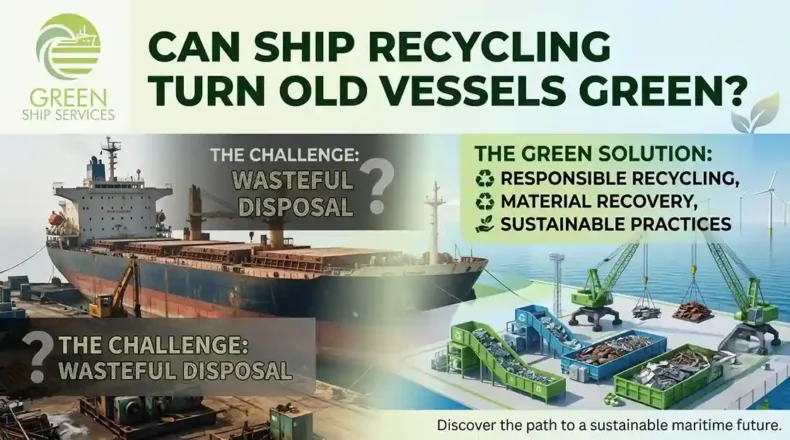
End-of-life vessels contain valuable steel, equipment, and other recoverable materials. Responsible recycling can recover these resources while supporting safer waste management, environmental protection, and a more circular maritime economy.
Can Ship Recycling Turn End-of-Life Vessels into Opportunity?
The global ship recycling industry connects end-of-life vessels, resource recovery, sustainable ship recycling companies, and regulated recycling facilities. When responsibly managed, recycling can return materials to productive use instead of sending valuable resources to waste streams.
The Hong Kong Convention entered into force on 26 June 2025, establishing mandatory international requirements for safe and environmentally sound ship recycling.
For shipowners and maritime stakeholders, this creates greater emphasis on:
- Environmental compliance
- Worker safety
- Hazardous-material management
- Responsible recycling facilities
- Documentation and certification
- Material recovery
- Circular-economy principles
How Does the Global Ship Recycling Industry Work?
How does the global ship recycling industry work? A vessel approaching the end of its operational life is assessed, prepared, transferred to an authorized recycling facility, and dismantled under applicable safety and environmental requirements.
A simplified lifecycle includes:
Vessel assessment → recycling planning → preparation → arrival at facility → safe dismantling → material segregation → hazardous-material management → resource recovery → responsible disposal
The IMO describes ship recycling as a practical end-of-life option because much of a ship’s material and equipment can be reused or recycled.
Why Is Sustainable Ship Recycling Important?
Ships can contain hazardous substances such as asbestos, heavy metals, hydrocarbons, and ozone-depleting substances. Poor handling can create risks for workers and the environment.
A responsible approach therefore combines resource recovery with careful control of hazardous materials.
Key sustainability priorities include:
- Safe dismantling practices
- Controlled hazardous-material handling
- Worker training and protection
- Pollution prevention
- Waste segregation
- Material reuse and recycling
- Emergency preparedness
- Regulatory documentation
What Materials Can Be Recovered from End-of-Life Vessels?
An end-of-life vessel can contain substantial quantities of reusable and recyclable materials.
| Recoverable resource | Potential circular-economy role |
| Steel | Reprocessed into new steel products |
| Non-ferrous metals | Recovered for industrial applications |
| Machinery | Reuse or component recovery |
| Electrical equipment | Reuse or responsible material recovery |
| Furniture and fittings | Reuse where suitable |
| Selected equipment | Refurbishment or secondary use |
| Other materials | Segregation, recycling, or controlled disposal |
The IMO notes that recycled steel can require substantially less energy than producing steel from raw materials.
What Does the Hong Kong Convention Mean for Ship Recycling Services?
The Hong Kong International Convention for the Safe and Environmentally Sound Recycling of Ships establishes requirements covering ships and recycling facilities.
Its framework addresses:
- Ship design and preparation
- Ship recycling facilities
- Hazardous materials
- Worker health and safety
- Environmental protection
- Surveys
- Authorization
- Certification
- Reporting and enforcement
The Convention also requires authorized recycling facilities to have appropriate systems for worker safety, environmental protection, emergency preparedness, monitoring, reporting, and record keeping.
How Is India Building a Sustainable Ship Recycling Framework?
India has established a statutory framework through the Recycling of Ships Act, 2019. The Act provides for regulation of ship recycling through prescribed standards and enforcement mechanisms.
India is also a Party to the Hong Kong Convention. The IMO identifies India among the major ship recycling services in India countries covered by the Convention.
This regulatory environment makes compliance, facility authorization, hazardous-material management, worker protection, and documentation increasingly important for the Indian recycling sector.
What Makes an Environmentally Responsible Ship Recycling Company?
An Environmentally responsible ship recycling company should approach vessel recycling as more than dismantling metal.
Important considerations include:
- Regulatory compliance
Operations should follow applicable national and international requirements. - Hazardous-material controls
Potentially hazardous substances should be identified, handled, and managed appropriately. - Worker protection
Safety procedures, training, protective equipment, and emergency preparedness are essential. - Environmental safeguards
Recycling activities should minimize pollution and uncontrolled releases. - Resource recovery
Reusable and recyclable materials should be segregated and directed toward suitable recovery channels. - Documentation and traceability
Records support accountability throughout the recycling process.
What Are End-of-Life Vessel Recycling Services?
End-of-life vessel recycling services cover the coordinated activities involved in preparing and processing ships that have reached the end of their useful operational life.
Depending on the project, services may involve:
- Vessel assessment
- Recycling planning
- Documentation support
- Regulatory coordination
- Hazardous-material assessment
- Recycling-facility coordination
- Dismantling oversight
- Material segregation
- Waste-management coordination
- Compliance documentation
The exact scope depends on the vessel, flag, recycling destination, applicable regulations, and contractual requirements.
Why Is Hazardous-Material Management Crucial ?
Hazardous materials are one of the defining challenges of responsible ship recycling. The IMO specifically identifies asbestos, heavy metals, hydrocarbons, and ozone-depleting substances among materials that require attention.
Effective management can involve:
- Identification
- Inventory and documentation
- Safe removal or handling
- Segregation
- Appropriate storage
- Authorized treatment or disposal
- Worker protection
- Record keeping
This approach helps connect ship recycling compliance with occupational safety and environmental responsibility.
How Does Ship Recycling Support a Circular Economy?
Ship recycling can create a circular pathway:
Old vessel → dismantling → material recovery → processing → new products → reduced demand for virgin resources
This model gives steel, metals, equipment, and other usable materials another productive life.
The IMO describes ship recycling as embracing a “cradle to grave” concept because materials and equipment from ships can be reused in other forms.
Therefore, sustainable recycling can connect maritime operations with broader resource efficiency, material recovery, waste minimization, and circular-economy objectives.
What Are the Benefits of Sustainable Ship Recycling?
A responsible recycling model can contribute to:
- Resource recovery: valuable materials return to productive use.
- Waste reduction: recyclable materials are separated from disposal streams.
- Energy efficiency: recycled steel can require less energy than primary steel production.
- Worker safety: structured procedures help control occupational hazards.
- Environmental protection: hazardous substances receive controlled management.
- Regulatory confidence: documented compliance supports transparent operations.
- Circularity: materials remain within productive economic cycles for longer.
How Can Shipowners Choose a Recycling Service?
When evaluating Sustainable ship recycling companies, shipowners can examine several practical factors.
| Evaluation area | Questions to consider |
| Facility authorization | Is the recycling facility appropriately authorized? |
| Compliance | Does it follow applicable ship-recycling requirements? |
| Hazardous materials | How are hazardous substances identified and controlled? |
| Worker safety | What training and safety systems are implemented? |
| Environmental management | How are waste and pollution risks controlled? |
| Documentation | Are required records and certificates maintained? |
| Recycling plan | Is vessel-specific planning undertaken? |
| Material recovery | How are recyclable materials segregated and recovered? |
The IMO states that a ship recycling facility should have a Ship Recycling Facility Plan, while a vessel-specific Ship Recycling Plan is required before recycling under the Convention framework.
Why Is India Important to the Global Ship Recycling Market?
India is one of the major ship recycling countries globally. The IMO has identified India among the major recycling nations and notes that almost all global ship recycling is concentrated in a small number of countries, including India.
For an Indian maritime market increasingly shaped by international environmental expectations, sustainable practices can help align vessel recycling with modern safety, compliance, and circular-resource principles.
This makes a Sustainable ship recycling company in India relevant not only to vessel disposal but also to responsible material recovery and environmental stewardship. Check Patient’s testimonial click: https://shorturl.at/3yKFS
How Can Greenship Services Support Responsible Ship Recycling?
For organizations seeking Ship Recycling Service in India, Greenship Services can position its expertise around responsible maritime recycling, compliance awareness, environmental safeguards, and circular-economy principles.
A professional consultation can help shipowners and maritime stakeholders understand:
- Applicable recycling requirements
- Documentation expectations
- Hazardous-material considerations
- Facility-related compliance
- Vessel recycling planning
- Environmental and safety priorities
- End-of-life vessel management
Those seeking to Book ship recycling consultation can discuss their vessel’s characteristics, operational history, documentation, recycling requirements, and intended recycling pathway.
How Does the Global Ship Recycling Industry Work?
The global ship recycling industry processes end-of-life vessels through assessment, preparation, regulated dismantling, material segregation, hazardous-material management, resource recovery, and responsible waste disposal. International requirements such as the Hong Kong Convention promote safer and environmentally sound recycling practices.
Conclusion
Ship recycling can transform an end-of-life vessel into a valuable circular-economy resource when safety, compliance, environmental protection, and material recovery work together. With the Hong Kong Convention now in force, responsible recycling has gained a stronger global framework. For India, sustainable ship recycling offers an important pathway for recovering materials while supporting safer, transparent, and environmentally responsible maritime practices. Check map link : https://maps.app.goo.gl/F76XcWC6EcrVEvFh6
FAQ: Global Ship Recycling
What is ship recycling?
Ship recycling is the process of dismantling an end-of-life vessel so that usable materials and equipment can be recovered, while hazardous substances and waste are managed responsibly.
Why is sustainable ship recycling important?
It can recover valuable resources, reduce waste, support worker safety, and help minimize environmental risks associated with hazardous materials.
When did the Hong Kong Convention enter into force?
The Hong Kong Convention entered into force on 26 June 2025.
What is the Hong Kong Convention?
It is an IMO convention establishing international requirements intended to ensure that ships are recycled safely and without unnecessary risks to human health, safety, and the environment.
Is India involved in global ship recycling?
Yes. India is one of the major ship recycling countries and is among the Parties to the Hong Kong Convention.
What is an end-of-life vessel?
An end-of-life vessel is a ship that has reached the point where continued operation is no longer commercially or technically appropriate and is destined for recycling.
How can shipowners select a responsible recycling service?
They can evaluate facility authorization, regulatory compliance, hazardous-material management, worker safety, environmental controls, documentation, and vessel-specific recycling planning.